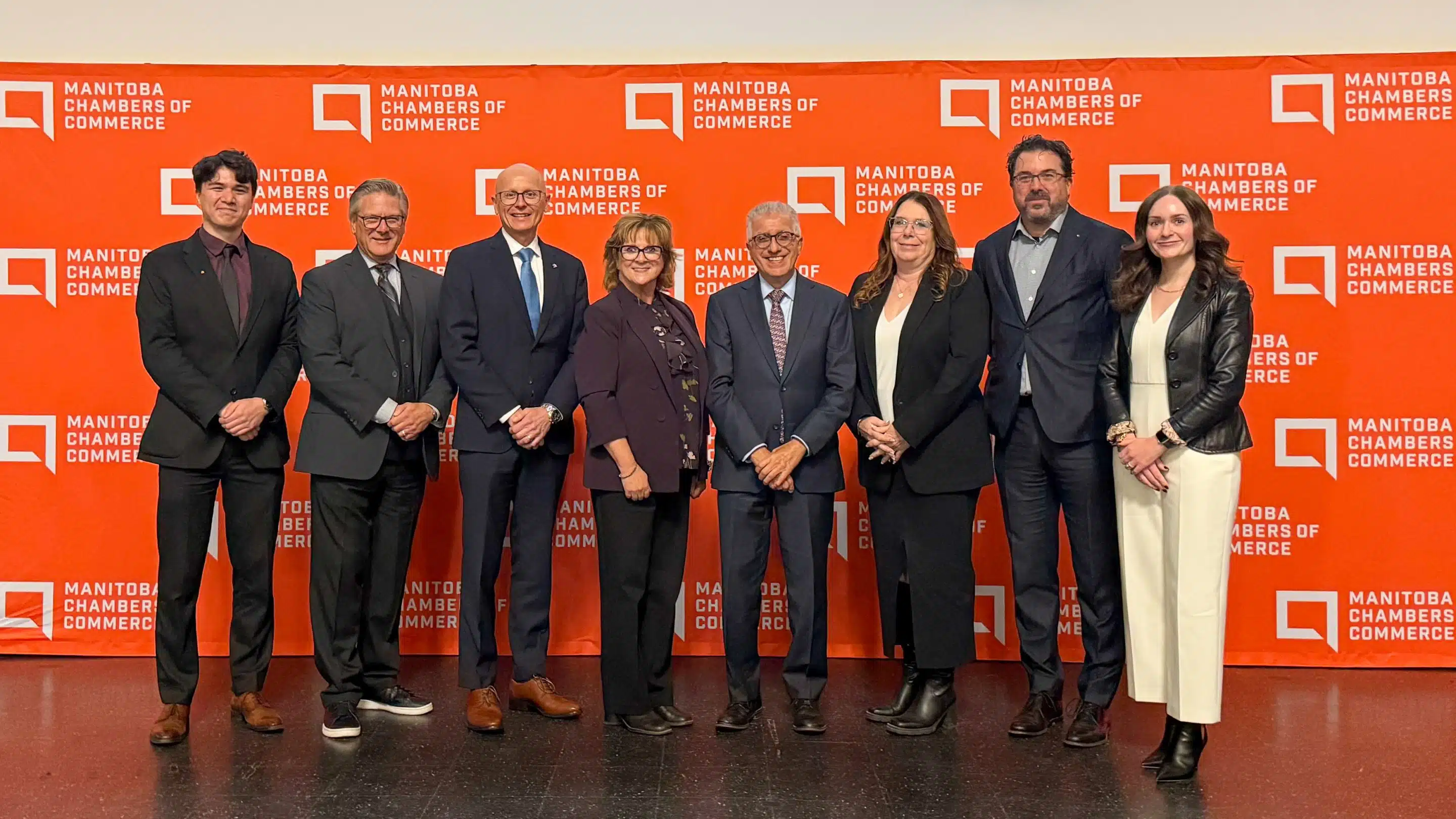
Manitoba’s universities and colleges have a unique opportunity to work together to prepare the province for its economic future, drawing on their strengths in education, research and innovation while building stronger connections between students, industry, government and communities.
That was the central message at the Manitoba Chambers of Commerce’s MBiz Speaker Series: The State of Post-Secondary, which brought together University of Manitoba President and Vice-Chancellor Dr. Michael Benarroch and RRC Polytech President and CEO Fred Meier to discuss Manitoba’s talent pipeline, research capacity, innovation potential and changing labour market.
The conversation was moderated by Beverlie Stuart, President and CEO of Manitoba Aerospace and Defence, who brought an industry perspective to the discussion and highlighted the importance of connecting education, research and workforce development to the needs and opportunities of Manitoba employers.
Working together to strengthen Manitoba
Meier noted that having Manitoba’s post-secondary leaders working at the same table allows institutions to consider challenges facing the sector as a whole and identify where they can complement one another.
Each institution brings different strengths to Manitoba’s education and training system. By working together, institutions can share expertise, reduce duplication, and create stronger pathways for students.
Benarroch emphasized that institutions are stronger when they build on one another’s strengths rather than duplicating programs and resources. He pointed to examples of collaboration between the University of Manitoba and RRC Polytech, as well as partnerships with other institutions such as University College of the North.
That collaborative approach can help Manitoba build greater capacity in sectors with significant growth potential, including aerospace, bioscience, advanced manufacturing, health care, and defence.
Connecting students with careers
A recurring theme was the importance of ensuring students graduate with the knowledge, and practical experience employers need.
Work-integrated learning, including co-op placements, internships and other forms of experiential learning, gives students opportunities to apply classroom knowledge in real workplaces while helping employers connect with emerging talent.
The conversation also highlighted the need to begin earlier. K-12 education can play an important role in helping students understand the vast range of career opportunities available in Manitoba and how educational pathways can lead to those careers.
Creating stronger connections between K-12 students, post-secondary institutions and employers, including opportunities for workplace experience, can make those pathways more tangible and help students make informed decisions about their futures.
Meeting demand and building capacity
Manitoba’s labour market is changing rapidly, with strong interest in health programs and skilled trades and growing consideration of careers shaped by artificial intelligence, automation, and emerging technologies.
RRC Polytech has experienced significant domestic enrolment growth, with Meier highlighting a 24 per cent increase. At the University of Manitoba, Benarroch pointed to the institution’s role in areas including health care and engineering.
The discussion made clear that Manitoba’s post-secondary institutions are already working to respond to industry demand. The challenge is increasingly one of capacity ensuring institutions have the instructors, facilities and infrastructure needed to grow programs and meet that demand.
Research, innovation and economic growth
The discussion also highlighted the role post-secondary institutions play beyond educating students. Manitoba has significant research and innovation expertise that can contribute directly to the province’s economic growth, particularly in areas such as aerospace, bioscience, advanced manufacturing, health care, and defence.
Benarroch pointed to Manitoba’s deep landscape of expertise, including research, aerospace, military and strategic policy, as an important asset for the province. The opportunity is not only to recognize those strengths, but to better connect them with industry and communicate them nationally.
Research partnerships between post-secondary institutions and businesses can help move ideas from the lab into the marketplace, while giving students opportunities to work alongside researchers and industry professionals. Those connections can strengthen Manitoba’s talent pipeline while supporting innovation and productivity.
Building Manitoba’s future
Ultimately, Manitoba’s workforce and economic opportunities cannot be addressed by post-secondary institutions alone. Employers, government, and the K-12 system all have important roles to play in building pathways for students, supporting educational capacity and strengthening connections between research, innovation and industry.
The MBiz discussion reinforced that Manitoba already has significant strengths and the opportunity is not simply to prepare people for the jobs of today, but to build the talent, research capacity and innovation ecosystem needed to create and compete for the opportunities of tomorrow.
Thank you to our MBiz Series event sponsors: 6P Marketing, Keystone Agricultural Producers, Miller Environmental, Manitoba Egg Farmers, World Trade Centre Winnipeg, CPHR, Travel Manitoba, Canadian Beverage Container Recycling Association, the University of Winnipeg Foundation and The Free Press as well as every attendee who has prioritized our events this season.