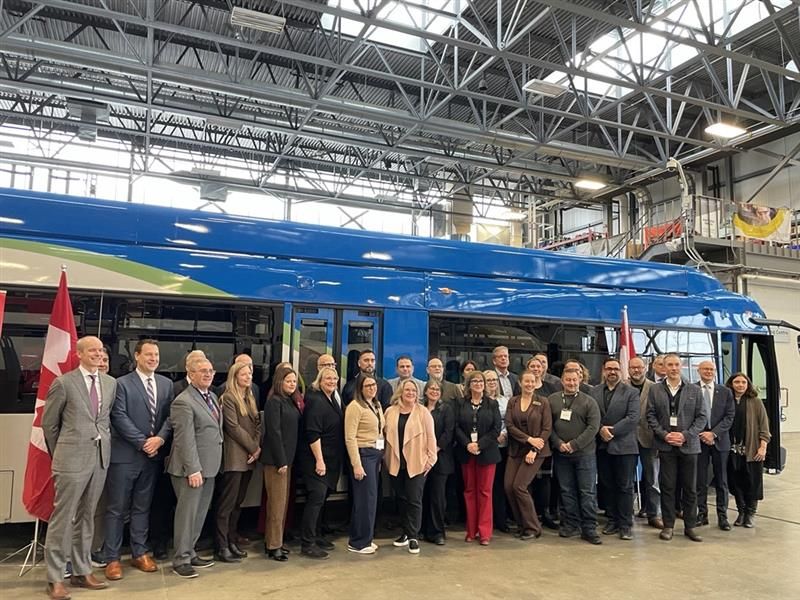
On December 16, the Manitoba Chambers of Commerce hosted a delegation from the Alberta Chambers of Commerce in Winnipeg for a focused interprovincial trade mission. The two-day visit brought together Alberta manufacturers, municipalities, and economic development leaders to explore practical opportunities to strengthen trade and supply chain connections between the two provinces.
This was the first interprovincial trade tour of its kind between the Alberta and Manitoba chamber networks. The goal was clear: move beyond high-level discussion and give businesses a direct view into capabilities, infrastructure, and partnerships that can support made-in-Canada procurement and reduce supply chain risk.
Grounding Trade in Real Capabilities
The delegation toured advanced manufacturing, logistics, and applied research facilities that play a central role in Manitoba’s industrial economy. The tour stops included New Flyer Industries, Fort Garry Fire Trucks, ROCKGLASS, CentrePort Canada, and RRC Polytech’s Vehicle Technology and Energy Centre.
For Alberta companies navigating tariff exposure, procurement uncertainty, and supplier concentration, the visits demonstrated that prairie-based capacity exists and can be scaled. Seeing operations first-hand helped compress due diligence, build confidence, and accelerate conversations from interest to potential collaboration.
Connecting Policy to Business Reality
Interprovincial trade is often framed as a policy challenge. This mission focused on how businesses move products, build supplier relationships, and manage risk across provincial lines.
A manufacturing and supply chain panel at RRC Polytech reinforced that perspective. Industry leaders emphasized that supply chain resilience starts close to home, scaling from regional and provincial capacity to interprovincial corridors before reaching national or global markets. That inside-out approach reflects how manufacturers de-risk sourcing and investment decisions.
Panel discussions also highlighted common constraints facing Canadian manufacturers, including tariffs, workforce shortages, procurement uncertainty, and the challenge of finding reliable domestic suppliers. While there was strong interest in buying Canadian, participants were clear that visibility and capability gaps often stand in the way. Discoverability of suppliers, consistent standards, and predictable procurement were identified as critical enablers of interprovincial trade.
Federal Engagement and Workforce Alignment
The program included a business breakfast with The Honourable Rebecca Chartrand, Minister of Northern and Arctic Affairs and Minister responsible for the Canadian Northern Economic Development Agency, followed by a meet-and-greet with The Honourable Eleanor Olszewski, Minister of Emergency Management and Community Resilience and Minister responsible for Prairies Economic Development Canada.
Discussions focused on aligning federal tools with regional strengths and reinforcing the role of domestic supply chains in economic resilience. Workforce availability emerged repeatedly as a cross-cutting issue, with manufacturers and educators pointing to the need for stronger training pipelines, applied research partnerships, and greater mobility of skilled talent across provincial borders.
From Dialogue to Action
Interprovincial trade remains one of Canada’s most achievable economic opportunities, yet unnecessary friction persists. What distinguished this mission was its emphasis on execution, relationship-building, and practical business considerations.
The Manitoba Chambers of Commerce looks forward to continuing this work with the Alberta Chambers of Commerce, participating businesses, and partners. Strengthening prairie supply chains and enabling interprovincial trade will require sustained collaboration, but this mission demonstrated that progress is most effective when business experience leads the conversation.