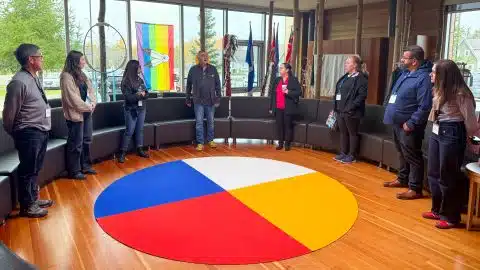
On July 8, MCC staff toured Whiteshell Laboratories — a critical site in Canada’s nuclear history and one with growing relevance as Manitoba charts a path toward a clean, resilient economy. The visit was part of the Manitoba Green Advantage (MGA) initiative and aligns with the Priority Actions outlined in Manitoba’s Roadmap for a Green Economy.
Our objective? To explore how this legacy site could support Manitoba’s broader energy strategy and unlock new economic development opportunities — particularly as we work toward net-zero targets and long-term sustainability.
Why Whiteshell — and Why Now?
Located near Pinawa, Whiteshell Laboratories was home to WR-1, an organic-cooled research reactor that played a formative role in Canada’s nuclear R&D. Though the WR-1 was decommissioned decades ago, the site remains active — staffed by more than 500 skilled professionals and licensed by the federal regulator.
But this is more than a footnote in our scientific history. Whiteshell helped lay the foundation for the CANDU reactor — a made-in-Canada technology that now powers homes and industries in Ontario, Argentina, South Korea, and beyond. Manitoba was part of that story.
So the question is: could Whiteshell help write the next chapter — one defined by clean energy innovation?
What About Nuclear? And Why Should We Care?
Fair question. Nuclear energy is not without its complexities, and it’s not the only clean energy solution there is. But as outlined in the Roadmap for a Green Economy, small modular reactors (SMRs) deserve serious attention for several reasons:
- Zero operational GHGs: SMRs emit no greenhouse gases during operation — making them a strong potential partner to Manitoba’s hydro grid, especially in industrial or remote settings.
- Smaller footprint: Compared to wind or solar, SMRs require significantly less land to produce the same energy output.
- Reliable baseload power: They provide 24/7 power, supporting industries that can’t afford fluctuations if they’re serious about decarbonizing.
- Flexible and scalable: Modular designs allow for more manageable, phased development — in contrast to traditional mega-projects.
This isn’t about replacing hydro or sidelining renewables. It’s about building a complementary toolkit to help Manitoba meet our energy needs, emissions targets, and economic goals.
Not Just History — A Head Start
What makes Whiteshell compelling isn’t just its legacy — it’s its readiness.
The site already offers:
- Grid and power infrastructure
- Physical space and established safety protocols
- A trained and experienced workforce
- A supportive host community that understands the site’s role
- Proximity to major transportation assets like highways and CentrePort
This isn’t a blank slate. It’s a platform with real potential — one that could attract investment and talent with the right vision.
Beyond SMRs: A Clean Energy Innovation Hub
While SMRs are one possible application, Whiteshell’s future could be far broader. With the right approach, the site could evolve into a full-spectrum clean energy innovation hub — focused on research, demonstration, and commercialization of:
- Green hydrogen production
- Long-duration energy storage
- Advanced grid and microgrid systems
- Clean fuels and industrial decarbonization pilots
- Carbon capture technologies
In short: not just a power site, but a catalyst for Manitoba-grown clean tech.
Canada’s Nuclear Strategy — and Manitoba’s Window
The federal government has identified SMRs as a strategic clean energy priority. With policy, funding, and regulatory frameworks advancing quickly, Canada is being closely watched — not just for its technology, but for how it leads on safety, public engagement, and Indigenous partnerships.
For Manitoba, Whiteshell represents a rare opportunity: a licensed, legacy site with community support, embedded in our clean energy landscape. That’s a strong foundation — and it won’t stay idle forever.
MGA’s Role: Ask First, Decide Later
We know nuclear energy raises questions. So we’re creating space to explore them — by bringing together diverse voices from business, community, academia, and government. This tour was one step in that process. More engagement is coming.
We’re focused on transparency, curiosity, and making decisions rooted in facts — not fear or assumptions.
What Comes Next?
As Manitoba builds momentum toward a low-carbon economy, we need to keep asking the big questions:
- What energy mix will support our industries?
- What infrastructure can create jobs and attract investment?
- How do we ensure affordability, reliability, and climate responsibility?
Innovation isn’t new to Manitoba — it’s part of our DNA. With care, collaboration, and courage, it can be part of our future, too.